
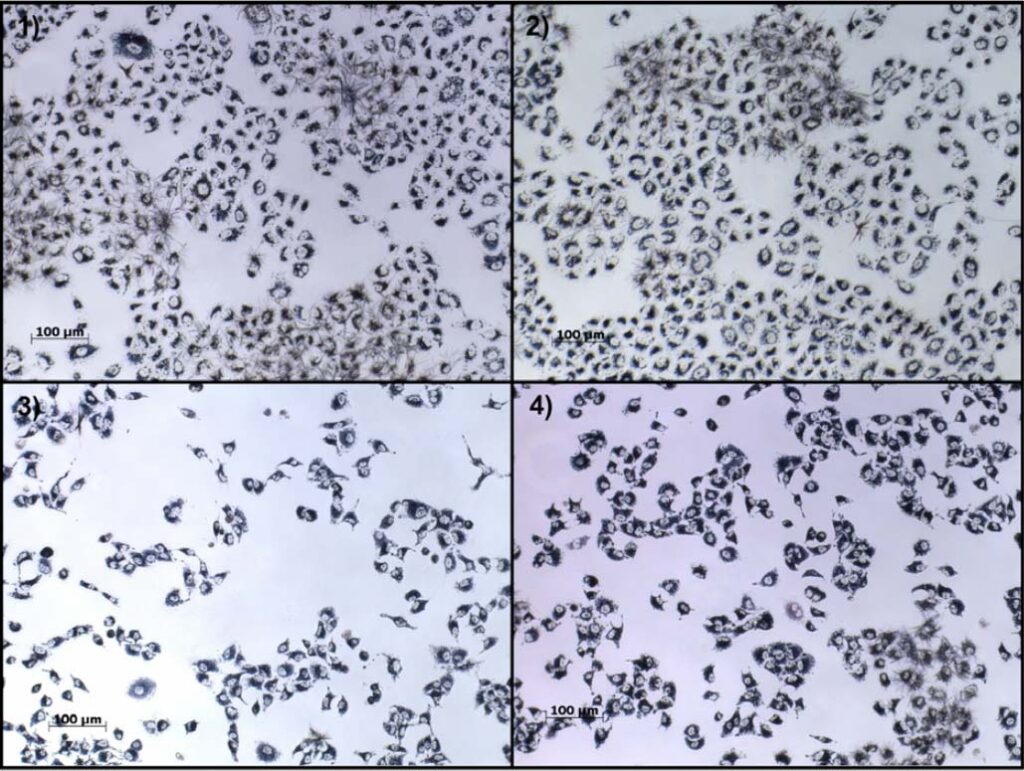
The viability of cells in cytotoxicity assays is always calculated relative to untreated control cells that undergo the same seeding and exposure procedure but receive only crude extraction media that has been incubated without the test item. Moreover, the spectrometric signal measured for a specific well in the assay is always corrected by blanks in the assay where the absorption background is measured in wells that received the assay reagent but incubation took place without cell. The variability of the measured absorption within the blanks as well as within untreated control cells depends strongly on the type of assay conducted and the procedure and parameters chosen for cell seeding, incubation and assay reagent exposure.
Sources of variability for the measured absorption signal measured among blanks and untreated control cells is dependent on parameters such as the chosen cell seeding density, duration of the cell proliferation/attachment phase before extract exposure and duration of the assay reagent incubation period. Taken all together the procedure and parameters chosen for a certain type of assay define its specific sensitivity. Or to put it another way, the higher the variability of the measured spectrometric signal within blanks and untreated control cells, respectively, the lower the ability of the assay to capture minor effects of the extracts on cell viability. Parameters having a strong impact on the baseline variability of an assay are therefore typically optimized during assay development (Lutter et al., 2017; Matt, 2008). Minimum requirement for a quantitative cytotoxicity assay to be in compliance with ISO 10993-5 is to demonstrate during validation that a decrease of cell viability by 30% or more is a statistically significant effect and not just a random effect due to the baseline variability of the assay. Inter-assay variability in the observed cytotoxic effect of an extract can be due to the fact that the colorimetric change of assay reagents is linked to different cellular functions such as mitochondria function (MTT, XTT, WST-1, Resazurin), lysosomal integrity (Neutral red), cell growth (Sulforhodamin B, BCA) and membrane integrity (Trypan blue), respectively. Moreover, inferences of extracted chemicals with the conversion of the assay reagent can have an impact on the extent of the measured cytotoxic effect (Scarcello et al., 2020). Depending on the type of interaction of the extracted chemicals with the assay reagent, this may lead to false positive or false negative outcomes.